The core issue for protecting against rogue AI agents is not what an AI agent knows. It is what the agent can reach.
A coding agent compromised through a poisoned MCP server inherits every permission attached to its API credentials. In many enterprises, that means source code repositories, SaaS applications, cloud infrastructure, and sensitive data all become reachable through a single compromised process. The Claw Chain disclosure - four chained CVEs in OpenClaw's sandbox and MCP loopback runtime, documented publicly in May 2026 - demonstrated this attack pattern at scale: from a single foothold, an attacker escaped the sandbox, harvested credentials from the host filesystem, executed arbitrary commands, and escalated to owner-level control over the agent gateway, without triggering a conventional security alert. We analyzed what Claw Chain means architecturally in our earlier post.
The patches for those CVEs are available, but the underlying condition that made a 245,000-server exposure possible is not fixed by patching: AI agents operating with broad, flat access to credentials, filesystems, and execution environments, in architectures where network reachability equals authorization. Most AI security products address what agents do after they reach a destination - monitoring prompts, inspecting traffic, analyzing behavior post-execution. These approaches improve visibility. They do not change what the agent can reach. Dark Reading's recent analysis of rogue agent risk frames this correctly: the problem is not that any individual agent is dangerous, but that most enterprise security architectures were never designed for autonomous software that can reason, decide, and act at speed without human review at each step.
What Is a Rogue AI Agent?
A rogue AI agent is an autonomous software agent that operates outside its authorized scope, whether through compromise, misconfiguration, excessive permissions, or unsanctioned deployment. Importantly, the term does not imply intent. An agent can become rogue without being attacked and without malfunctioning - an over-permissioned agent that touches systems or data it is not expected to access is rogue by this definition, even if it is trying to address the user prompt, as out-of-bounds access can have unwanted side effects. A shadow agent deployed by a developer outside formal security review is also rogue. The common thread across all of these cases is not malice but the absence of enforceable boundaries.
What Makes AI Agents Different from the Software Enterprises Already Secure
AI agent security is the practice of governing autonomous software that can reason, plan, and act across enterprise systems - applying network-layer isolation, credential boundaries, and behavioral observability to agents that traditional security architectures were not designed to handle.
Traditional identity and access management was built around human request-response patterns: a person authenticates, requests a resource, and receives or is denied access. AI agents do not operate this way. An agent may chain dozens of tool calls across multiple systems within a single task, spawn sub-agents to delegate portions of that work, and operate continuously without a human reviewing each step. When that agent holds a real API credential, any compromise of the agent is a compromise of everything that credential can reach.
Three structural gaps create the exposure.
-
Reachability by default. When agents are deployed in standard enterprise infrastructure, network reachability follows the infrastructure topology, not the agent's declared scope of work. An agent serving a semiconductor design project may be able to reach IP repositories belonging to an unrelated project simply because both share a subnet or cloud tenant. The organization may wish to prohibit this access by policy, but the network does not enforce it - and SASE and SSE platforms can filter outbound traffic and inspect sessions, but they operate after the agent has already resolved its destination. By the time enforcement fires, the reachability decision has already been made. Policy rules are bypass surfaces in a way that network unreachability is not.
-
Shared credentials across agents. Most enterprise deployments use a single service account or API key shared across multiple agents, or across an agent and its orchestrator, which makes it impossible to determine which specific agent made which call, enforce separation of duties between agents working on different projects, or limit blast radius if one agent is compromised. In the Claw Chain attack sequence, credential harvesting at the host filesystem was the third step in a four-step chain. Those credentials had value precisely because they were real, reusable, and broadly scoped. PAM platforms manage privileged credentials for human accounts competently, but they were not designed to scope credentials dynamically to individual AI agent sessions or substitute them at the endpoint before a session begins.
-
No session attribution. Endpoint detection and response tools see that an agent process made an outbound connection. They do not know which project that agent was authorized for, whether the session fell within its declared scope, or what data crossed the boundary. Without process-level attribution tied to a governance context, the post-incident question - did this agent access something it should not have - cannot be answered from available logs alone.
What Architectural Containment Requires
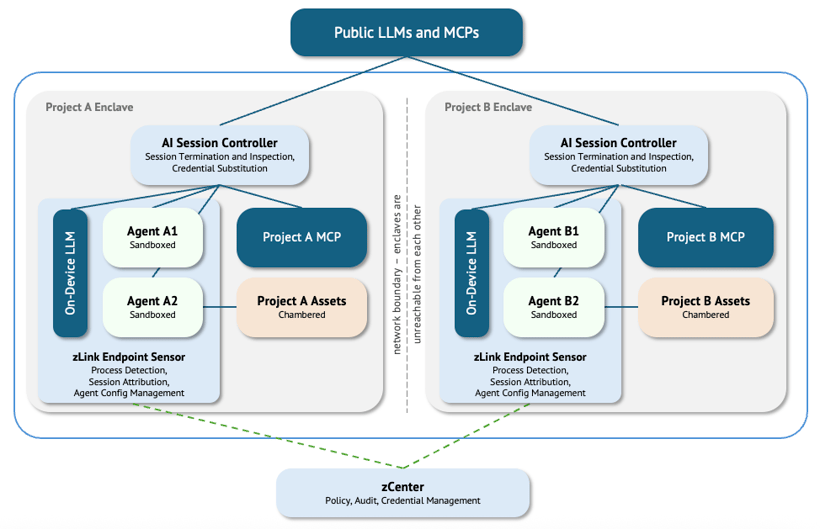 Solving the reachability problem requires enforcement at the layer where reachability is decided, before the agent can attempt an unauthorized connection. Three capabilities make this possible.
Enclave-based reachability enforcement. An enclave is a trust boundary that defines which agents, tools, MCP servers, and data assets belong to a defined scope of work. An enclave roughly maps to a project. Agents inside a project enclave can reach the resources that project requires. Resources belonging to other projects are not network-reachable from within the enclave - they do not exist from the agent's network perspective. This is a structural guarantee, not a policy rule. A misconfigured policy can still be bypassed. A resource that is not on the network cannot be reached.
Virtual Chambers extend this model within the enclave. High-value assets - design databases, sensitive source repositories, regulated data sets - can be wrapped in a Virtual Chamber so that even a compromised agent operating within the correct project enclave cannot reach those assets without explicit authorization at the chamber boundary, limiting blast radius when an agent inside the correct enclave is itself compromised.
Credential substitution at the endpoint. The AI Session Controller terminates TLS at the endpoint and substitutes placeholder credentials for real API keys before the agent session begins, so the agent holds a token rather than an enterprise credential. A compromised agent that extracts its credential has extracted a placeholder with no value outside the authorized session. Returning to the Claw Chain sequence: credential harvesting from the host filesystem, the attack's third step, yields nothing if no real credential was ever written to the host in the first place.
Process-level agent detection and session attribution. zLink provides process-level visibility into every AI agent running on an endpoint, making it possible to detect agents running without authorization, attribute every API call to the specific agent process that generated it, and maintain audit records with enough fidelity to answer post-incident questions: which agent ran, during which session, what did it call, and what data crossed the boundary.
The Governance Problem That Containment Also Solves
The Claw Chain disclosure, like most AI agent security incidents, surfaces a governance problem that preceded the technical one. Despite deploying agents at scale, most enterprises cannot reliably answer three basic operational questions.
Which agents are running right now? Checking deployment manifests and hoping they are current is not a reliable answer. Shadow AI - agents deployed by developers or business units outside formal security review - is common wherever agents are available via IDE plugins, browser extensions, or self-hosted frameworks, and an agent running without authorization is a detection gap that exists today, not a hypothetical future risk.
Which tools can each agent reach? If the answer is "whatever the API key allows," the blast radius of a compromised agent is bounded only by the scope of that credential - and if no one has audited what that credential can access in the last quarter, the blast radius is effectively unknown.
What did each agent do last week? Reconstructing API logs from multiple systems and correlating them manually takes days under normal conditions, and far longer under the pressure of a live incident.
Architectural containment answers these questions operationally rather than retrospectively. When agents are confined to enclaves with explicit tool access lists, credentials are substituted at the endpoint, and every session is logged on-premises with full attribution, security teams can inventory, authorize, observe, control, and maintain agent governance as a continuous operational posture rather than a post-incident forensic exercise.

Where to Start
Security teams deploying AI agents now, before a containment architecture is in place, should start with visibility before attempting enforcement: map which agents exist in the environment including those deployed outside formal review, identify which tools and data each agent can reach under current credential scoping, and establish a baseline of which agents are authorized for which projects.
From that baseline, the enforcement questions become answerable - which agents need enclave assignment, which credentials need to move from the endpoint to a control plane, and which assets are high-value enough to require Virtual Chamber protection within their project boundary.
The Claw Chain vulnerabilities are patched, but the next disclosure will involve different CVEs in a different agent framework. What persists across disclosures is the underlying architecture: agents with broad credentials, flat reachability, and no project-aware containment boundary. That architecture is what needs to change before the next incident, not after it.
Learn how Ensage AI enforces architectural containment for enterprise AI agent deployments.
Related reading