

USE CASE

Defending Healthcare

Zero Trust for clinical continuity and patient safety.

You’ve hardened the EHR, but  attackers don’t need it to stop care. Protect the clinical devices, building systems, and shared services that determine whether care continues.

  • Extend Zero Trust protections to mission‑critical systems beyond the EHR, fast and without network redesign
  • Protect assets that can’t run agents or be patched using agentless/inline enforcement plus lightweight agents where supportable
  • Contain blast radius so disruptions become isolated events, not hospital‑wide downtime
  • Improve auditability with less workflow friction across clinicians, vendors, and shared services
I am a:

How Zentera Protects Critical Healthcare Systems

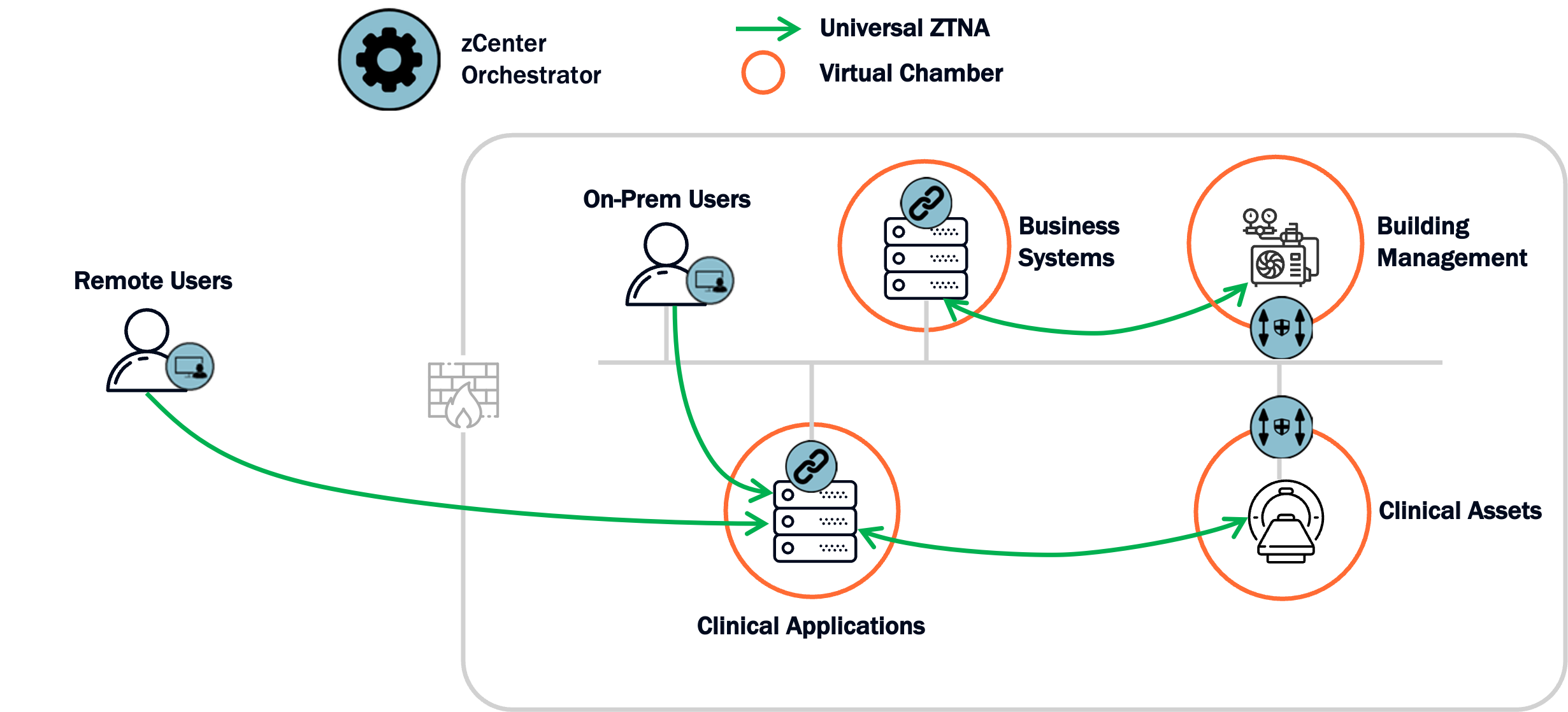
Epic, Meditech, and Oracle Health environments are often the most controlled part of a hospital. But ransomware doesn’t need the EHR to shut down care. If clinical devices, building systems, shared services, or lab feeders are disrupted, downtime becomes a patient safety event. Zentera extends Zero Trust enforcement to these exposed systems - fast, agentless where needed, and without redesigning your network.
Key Outcomes

  • Reduce downtime risk from ransomware and malware by enforcing least‑privilege connectivity
  • Strengthen resilience during surge events and emergencies
  • Improve auditability with less workflow friction across care delivery
  • Replace implicit zone trust with identity‑based, least‑privilege connectivity between systems
  • Stop lateral movement by enforcing what’s allowed and blocking everything else
  • Overlay enforcement that complements your existing NAC, firewalls, and visibility tools
Rapid Deployment
Zentera architecture diagram
1
2
3
4
HIPAA / HITECH NIST SP800-53 NIST SP800-207
See full architecture

How It Works

1
Assess

Identify the non‑EHR systems most likely to cause care disruption if compromised—and prioritize fast containment.

Inventory and map dependencies for exposed domains: clinical devices, building systems, shared services, lab/pharmacy/imaging workflows, and vendor pathways.


Choose the first scope (one facility, one campus, or one “critical dependency cluster”).

2
Deploy

Add enforcement without disrupting care; no multi‑quarter segmentation project required.

Deploy Zentera as an overlay and place enforcement where it fits: inline/agentless for fixed‑function assets and lightweight agents where supportable (e.g., on servers/workstations that broker access).


Connect to identity sources (IdP/Directory) and your logging pipeline.

3
Define

Replace broad “zone access” with who/what is allowed to reach each critical dependency.

Create least‑privilege policies for the initial scope: clinician access, vendor access, service‑to‑service, and admin paths.


Start with a clear allow‑list for the workflows that must function (lab → interfaces, pharmacy → dispensing, facilities → monitoring, etc.).

4
Enforce

Contain disruptions before they spread. Turn a hospital‑wide outage risk into a manageable, isolated event.

Enforce identity‑based connectivity and segmentation to block lateral movement between domains (devices ↔ shared services ↔ clinical platforms).


Reduce reliance on VLAN/firewall exception sprawl by enforcing policy at the overlay layer for the protected scope.

5
Validate & Expand

Prove value quickly (days, not quarters), then expand to the next priority system or site.

Validate workflows with clinical ops and IT, tune policies, and expand scope incrementally: one dependency set, building, clinic, or acquired site at a time.


Export enforcement signals to SIEM/SOAR and operationalize alerts for unauthorized access attempts.
At a Glance

Best for

Hospital and health system security teams, clinical engineering, facilities teams, and IT leaders focused on clinical continuity

Applies to

Hospitals, outpatient and dental networks, research/lab environments, distributed clinics, and acquired sites with inconsistent controls

Protects

Clinical devices and specialized systems, facilities/building systems (HVAC, power, access control), shared services, lab/pathology/pharmacy workflows, imaging/PACS-adjacent systems, and research networks

Enables

Agentless protection where endpoints can’t run security software, identity‑centric least‑privilege connectivity, lateral‑movement prevention, microsegmentation without rule explosion

Time to value

Deploy in days, not quarters. Start with highest‑risk dependencies and expand as you prove value

Integrations

Identity providers / directory services, SIEM/SOAR, asset discovery and visibility platforms, existing NAC and firewall programs

Key Outcomes
Reduce downtime risk from ransomware and malware
Contain blast radius to a defined scope vs full network exposure
Deploy in days not quarters
Improve auditability with less workflow friction
See all outcomes & KPIs

The Challenge

Healthcare security programs often focus where funding, governance, and vendor pressure are strongest. That work matters. But patient care depends on systems that are harder to secure: fixed‑function clinical assets, building controls, shared services, and domain‑bridging workflows like lab, pathology, imaging, and pharmacy.

When these are compromised, the outcome isn’t just data loss. It’s downtime: canceled procedures, diverted ambulances, delayed care, and patient safety risk. Cybersecurity is patient safety. Downtime is clinical risk.

What's still exposed:

  • Fixed‑function clinical assets that can’t run agents or be patched
  • Facilities and building systems converging with clinical operations (HVAC, power, access control, signage, elevators)
  • Clinical support systems that bridge domains (lab, pathology, pharmacy interfaces, specialty systems)

What's at stake: operational downtime, data exfiltration/extortion, regulatory exposure, recovery cost, reputational damage, and loss of patient trust.

Why Traditional Approaches Fall Short

1 Segment it with VLANs and firewalls
Why it fails

Years of exceptions and rule sprawl make zones porous and hard to maintain, especially as environments evolve.

Risk created

Minor breaches become lateral movement pathways across clinical, facilities, and shared services.

2 Install agents everywhere
Why it fails

Many medical devices and specialized systems can’t run agents and can’t be patched on typical IT timelines.

Risk created

The most operationally critical assets remain exposed.

3 Rely on visibility + NAC
Why it fails

Visibility doesn’t equal enforcement, and NAC coverage can be uneven across converged environments and acquisitions.

Risk created

You can see risky pathways, but still struggle to close them without disruption.

4 ZTNA for users
Why it fails

Traditional ZTNA is a user‑to‑app remote access tool and doesn’t reliably enforce least‑privilege connectivity inside the clinical ecosystem (on-prem users, systems talking to systems, and complex dependencies).

Risk created

Lateral movement remains possible through trusted internal paths.

The Zentera Approach

Zentera focuses on enforcement: stopping lateral movement and tightening access to critical dependencies, especially where agents and redesigns aren’t feasible.

Overlay Enforcement Across Domains

What it does: Enforces least‑privilege connectivity between systems without redesigning the underlying network
Why it matters: can protect critical dependencies quickly, even in complex, mixed environments.

Agentless Where Needed, Lightweight Agents Where Possible

What it does: Protects fixed‑function clinical assets and building systems using agentless/inline enforcement while supporting lightweight agents where feasible.
Why it matters: Extends Zero Trust to the systems traditional controls struggle to protect.

Microsegmentation Without Rule Explosion

What it does: Reduces VLAN sprawl and firewall complexity by enforcing “what’s allowed” with identity-based policies.
Why it matters: Reduces VLAN sprawl and firewall complexity by enforcing “what’s allowed” at the policy layer.

Reference Architecture

healthcare-full

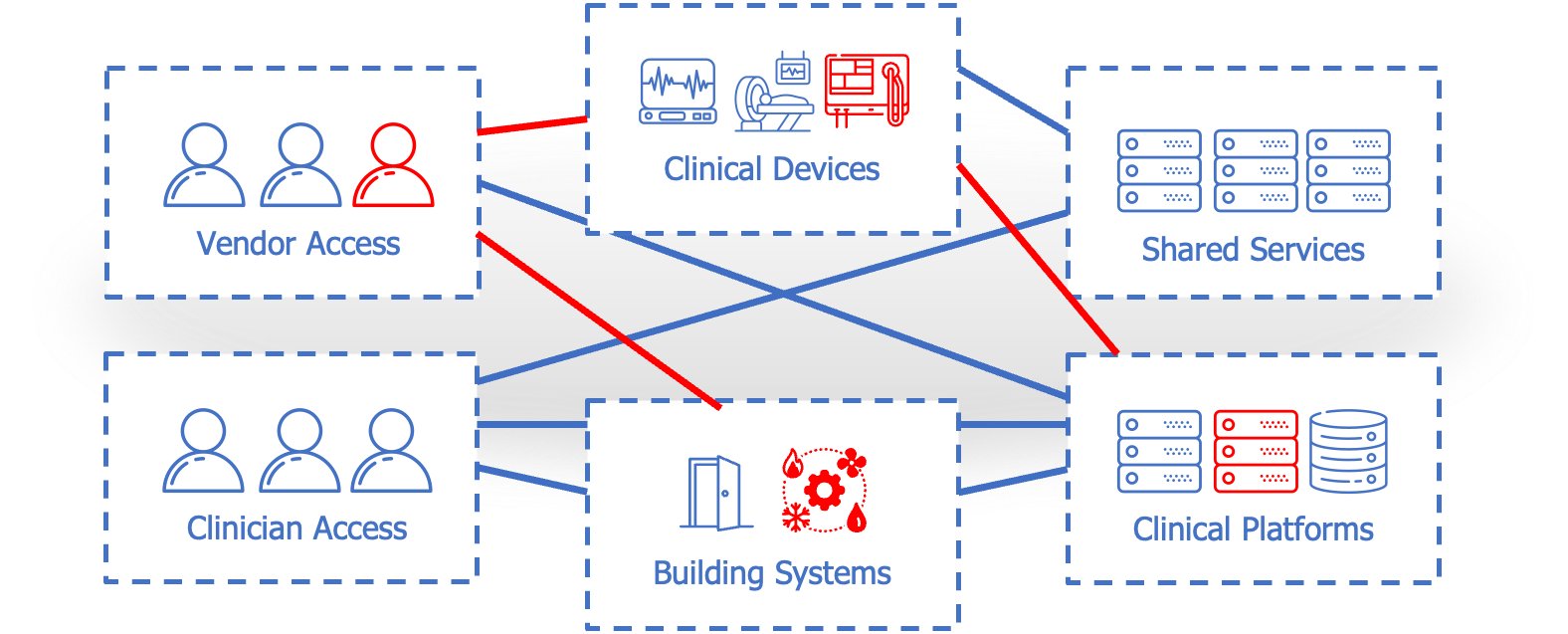
This architecture shows how Zentera overlays the healthcare environment and enforces least‑privilege connectivity between clinicians, vendors, clinical platforms, shared services, clinical devices, and building systems—reducing lateral movement and containing blast radius

1

Identity-based Access

Verified clinician and vendor access decisions replace implicit trust.

2

Overlay-based Enforcement

Zentera enforces allowed connectivity for the protected scope, without network redesign.

3

Critical Dependencies Protected

Shared services, facilities systems, and clinical support workflows are tightened so disruptions don’t cascade.

4

Clinical Platforms Remain Stable

Keep existing EHR governance; extend protection to what attackers use to stop care.

What Changes

  • From “zone trust” to identity‑based, least‑privilege connectivity
  • Lateral movement paths are reduced and controllable
  • You can start with the highest‑risk dependencies and expand incrementally

What Stays the Same

  • Core network architecture and existing security stack (NAC, firewalls, visibility)
  • Clinical workflows (validated and tuned during rollout)
  • EHR governance model: this extends it to the rest of the clinical ecosystem

Key Capabilities

Simplify segmentation programs that have stalled under VLAN sprawl and exception overload—without adding complexity to an already stretched team.

Start protecting highest-risk dependencies in days, not quarters—without rip-and-replace projects that compete with clinical priorities.

Extend the value of your current NAC, firewalls, and visibility tools by adding the enforcement layer they lack—not replacing what you've already built.


Protect medical devices, building systems, and specialized clinical assets that can't run agents or be patched on typical IT timelines.

Enforce identity-based policies that control who and what can reach each system—clinicians, vendors, shared services, and clinical support workflows.

Shrink reachable paths between clinical devices, facilities systems, shared services, and platforms so a breach in one domain can't cascade into others.


Implementation Details

Deployment & Operations

Where it runs Customer‑hosted control plane or SaaS (authorized partners/MSSPs)
Deployment model Overlay enforcement; agentless/inline where needed + lightweight agents where supportable
Timeline Day 1 assess → Day 3 enforce → Week 1 validate and expand
Ownership Security + IT lead policy; clinical engineering/facilities validate operational dependencies; SOC monitors enforcement signals
Operational Impact Minimal disruption; incremental adoption by risk‑based scope

Outcomes & KPIs

Security

Operational Risks Reduced risk of operational shutdown from ransomware and malware
Blast Radius Contained to a defined scope vs. full network exposure
Lateral Movement Reduced lateral movement in exception-heavy zones

Operational

Implementation Time Faster implementation than infrastructure-based segmentation programs
Complexity Less firewall/VLAN complexity and fewer brittle exceptions
Auditability Improved auditability with less workflow friction

Business

Business Continuity Stronger continuity during surge events and emergencies
Disruptions in Care Lower likelihood of canceled procedures/diversions due to cyber disruption
Compliance Advance Zero Trust maturity where traditional ZTNA and segmentation stall

Proven Results

Agility you just don't have in a traditional infrastructure

Luis Espinoza Sr Manager Siemens

The ability to grant vendors access to specific applications without VPN has transformed how we manage third-party maintenance.

OT Security Director Director of OT Security Energy Company