Get a Demo
USE CASE

OT Security

Secure IT/OT convergence for Industry 4.0 without firewall sprawl or production disruption.

  • Protect critical OT assets that can't support an agent
  • Leverage lightweight agents where supportable
  • Enable secure access for vendors and from IT
  • Microsegment IT/OT boundaries without network redesign
I am a:

How Zentera Secures OT

Zentera quickly isolates critical OT assets, ensuring cyber-resilience for operations that depend on brownfield networks.
Key Outcomes

  • Operations become cyber-resilient, even when networks are compromised
  • Unauthorized accesses stand out, even when attackers are "living off the land"
  • Meet compliance requirements without a network redesign
  • OT assets are segmented and isolated, without any network changes
  • Identity-based policies enforced at the workload level
  • Multi-factor authentication in the OT environment enforced in the network
Rapid Deployment
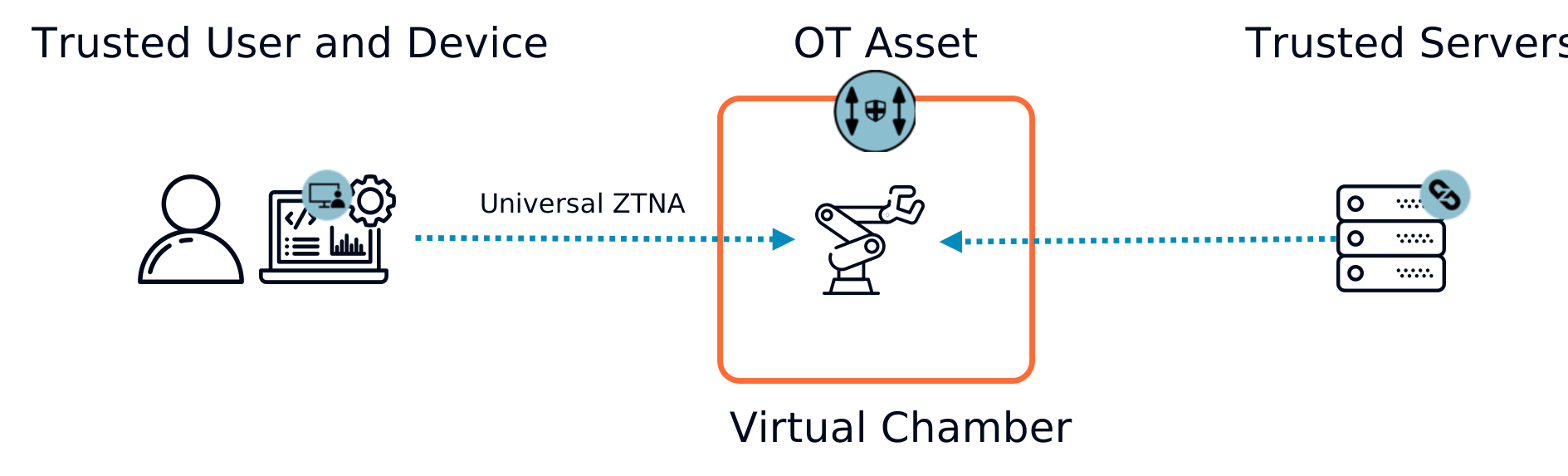
Simple diagram of Zentera OT security pattern, showing ZTG protecting an asset
1
2
3
4
NIST SP800-207 Zero Trust Fast Path to IEC62443 Prepare for NERC CIP-015-01
See full architecture

Getting Started

1
Deploy

Deploy Zentera

Install Zentera in your environment without operational disruption.

Deploy Zentera

Deploy the orchestrator, then install ZTG inline with critical assets and zLink agents where needed. No restart necessary.

2
Define

Define Your Protection

Assign devices to groups that can be protected based on function, risk level, or operational requirements.

Define Your Protection

Create Virtual Chambers into logically microsegmented groups. Transparent to the network: no change to application routing, IP addressing, VLANs, firewalls, or ACLs needed.

3
Learn

Learn Asset Behavior and Define Policies

View exactly what each asset connects to, and use the suggestions to build your business' definition of authorized accesses.

Learn Asset Behavior and Define Policies

Review application flows and accept/reject/edit suggested policies based on application identity and risk. All policies are human-readable for easy operational management and for audit purposes.

4
Enforce

Enforce Policies

Put your policies into action. Reject all unauthorized accesses, making your critical assets invisible to network threats by default.

Enforce Policies

Begin enforcing policies, requiring authorized users and applications to transparently undergo multi-factor authentication checks before they can access the asset. Instantly roll-back a policy if needed. 

5
Monitor

Monitor and Update

Watch for unauthorized sessions that can be a sign of network breaches. Update policies as your business requirements change.

Monitor and Update

Leverage your existing SIEM and SOC to filter out noise and focus on the actionable - unauthorized access attempts. Role- and identity-based policies help lean teams keep policy maintenance to a minimum.

At a Glance

Best for

OT security teams, plant operations, IT security teams managing converged environments

Applies to

Manufacturing, energy, utilities, critical infrastructure, building management systems, datacenter rack power controls

Protects

HMI, SCADA servers, PLCs, IoT/ICS devices, legacy systems, engineering workstations

Enables

Secure remote employee/vendor access, application-to-application connectivity, IT/OT microsegmentation

Time to value

First OT asset protected in days. Immediate risk reduction that compounds as the deployment expands.

Integrations

Identity providers (SAML 2.0, OAuth 2.0, LDAP), SIEM/SOAR platforms, asset discovery tools
FREE DOWNLOAD

Get the Solution Brief

Zentera Solution Brief - IT-OT Security

Key Outcomes
90%+ Attack surface reduction
Days Time to first protection
Zero Production disruption
100% Access visibility
See all outcomes & KPIs

The Challenge

Industry 4.0 initiatives are connecting OT environments to IT networks at an unprecedented pace. Remote access requirements, cloud integration, and data-driven operations are expanding the attack surface of critical infrastructure.

Meanwhile, ransomware operators and nation-state actors are increasingly targeting OT systems, knowing that production downtime creates immediate pressure to pay. Traditional security approaches struggle to protect environments where patching is impossible and network changes risk production.

What's at stake: Production downtime, safety incidents, regulatory penalties, and reputational damage from OT security breaches that can't be contained - not to mention potential physical harm.

Why Traditional Approaches Fall Short

1 VPN for remote access
Why it fails

Grants network-level access to entire OT segments

Risk created

One compromised credential exposes all connected assets

2 Firewall rules between IT/OT
Why it fails

Exception requests accumulate over time

Risk created

Firewall rule sprawl creates invisible attack paths

3 Air-gapping critical systems
Why it fails

Business requirements force connectivity

Risk created

Shadow IT connections emerge outside security visibility

4 Network-based "agentless" segmentation
Why it fails

Switches and routers have limited ACLs; organizations have a wide range of gear and assets all over - including in the cloud.

Risk created

Segmentation becomes unwieldy - works in some places, works differently (or doesn't work) in others.

The Zentera Approach

Zentera's Virtual Chamber architecture delivers Zero Trust outcomes for OT environments - agents for workloads that support them, agentless for those that don't - all without network redesign, or production downtime.

Identity-Based Access

What it does: Verify user and device identity before granting access to specific OT applications
Why it matters: Eliminates implicit trust from network location; stolen credentials can't traverse the network

OT Microsegmentation

What it does: Wrap OT assets in Virtual Chambers that enforce least-privilege access policies
Why it matters: Contains lateral movement at the application layer without touching OT networks

Overlay Connectivity

What it does: Create encrypted tunnels between authorized users and protected resources
Why it matters: OT assets become invisible to unauthorized scanning; no inbound firewall rules required

Reference Architecture

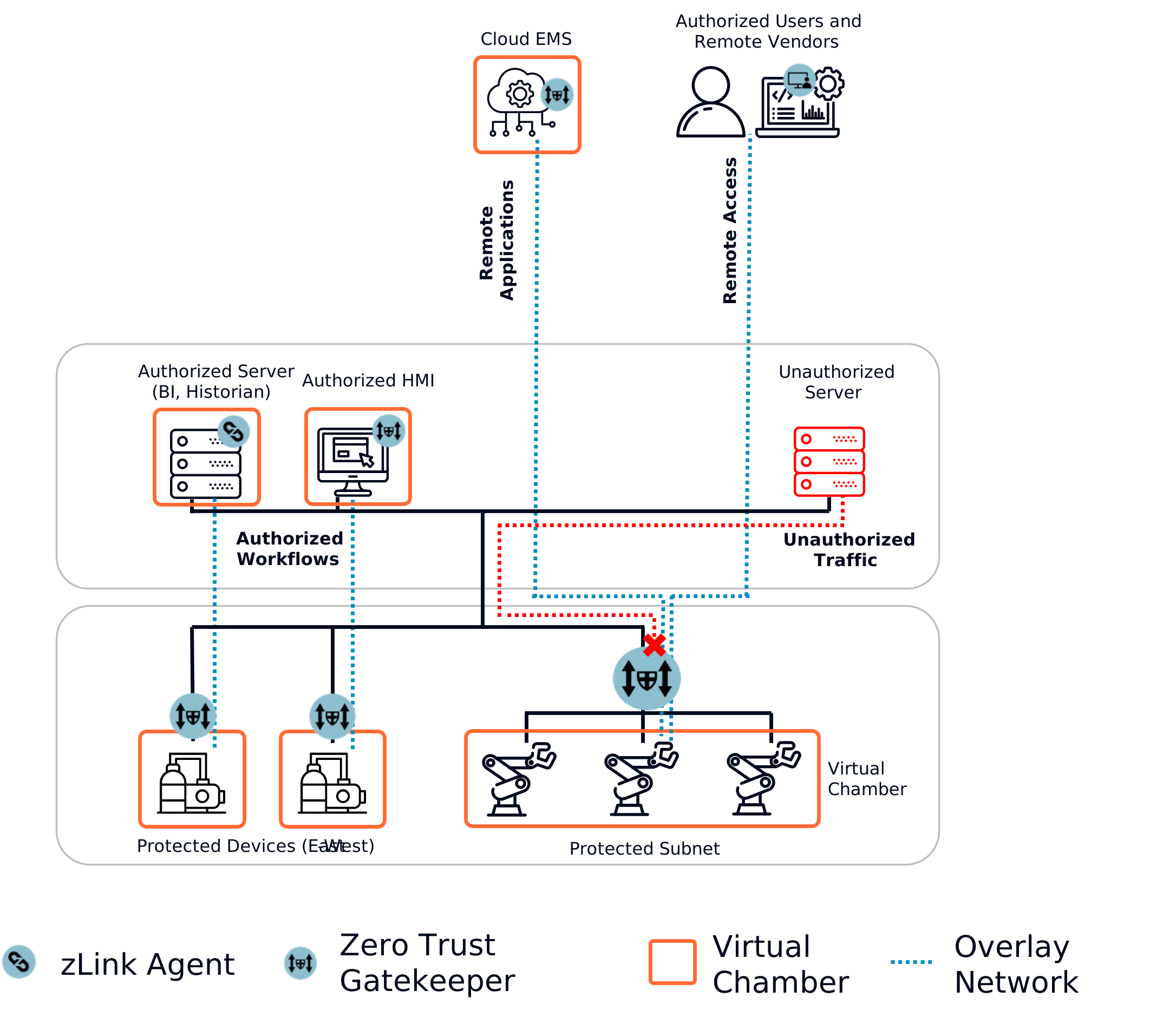
OT-full

This diagram illustrates how Zentera's Virtual Chamber architecture protects OT environments, containing assets and enforcing access from authorized users, devices, and software.

1

Identity Verification

Users authenticate through existing IdP before accessing any OT resources

2

Virtual Chambers

OT assets are wrapped in policy-enforced chambers that define allowed connections

3

Zero Trust Gatekeeper

Inline security with configurable fail-open to maintain asset availability in the case of failure

4

zLink Agents

Lightweight agents enforce policies on compute devices (HMIs, servers)

What Changes

  • Access control moves from network to identity layer
  • OT assets become invisible to unauthorized users
  • Vendor access constrained to specific applications

What Stays the Same

  • Existing network infrastructure and IP addressing
  • OT system configurations and operations
  • Current firewall rules (Zentera adds, doesn't replace)

Key Capabilities

Grant third-party vendors access to specific applications with time-limited, auditable sessions—no broad network exposure and no VPN infrastructure to manage.

See every access attempt—allowed and blocked—with exportable logs for SIEM/SOAR integration, regulatory evidence, and cyber insurance positioning.

Overlay architecture means no changes to OT networks or devices. Protect the first critical asset in days, then expand—without maintenance windows, outages, or production risk.

Protect legacy OT systems, PLCs, and fixed-function devices with an inline Zero Trust Gatekeeper—configured to fail open or closed based on your availability requirements.

Wrap OT assets in Virtual Chambers that enforce least-privilege connectivity without touching network infrastructure, IP addressing, or VLAN configurations.

Connect to your existing IdP (Okta, Azure AD, etc.) and enforce multi-factor authentication and conditional access for OT resources—even in environments that have never had identity-based controls.

Benefits of Zentera OT Security

Deployment & Operations

Where it runs Customer-hosted control plane or authorized MSSP
Deployment model SaaS or on-premises
Timeline First protection in days, full deployment in 4-6 weeks
Ownership Security team manages policies; IT manages infrastructure

Outcomes & KPIs

Security

90%+ reduction in OT attack surface
Zero lateral movement paths between protected assets
100% visibility into OT access attempts

Operational

75% faster vendor access provisioning
Zero production disruption during deployment
Minutes to revoke access across all OT systems

Business

Compliance with NERC CIP, IEC 62443, NIST frameworks
Insurance favorable cyber insurance positioning
Continuity protection without production impact

Proven Results

Zentera successfully defended against the real-world OT attacks I threw at it. I was impressed. This Zero Trust stuff works.

CTO Chief Technical Officer Security Evaluation Firm

Strong protection, easy to use and administer.

Sreeni Kancharla VP and CISO Cadence