 On May 15, 2026, Cyera's research team disclosed a chain of four critical vulnerabilities in OpenClaw, one of the fastest-growing open-source platforms for autonomous AI agents. The exposure left an estimated 245,000 publicly accessible server instances open to remote code execution, credential theft, and persistent backdoor installation. All four CVEs have since been patched. The agent security problem has not.
The OpenClaw disclosure is important not because it is unusual but because it is instructive. The vulnerabilities are real. The CVEs are assigned. The patch is available. And none of that changes the underlying condition that made a 245,000-server exposure possible: AI agents operating with broad, unsegregated access to filesystems, SaaS applications, credentials, and execution environments, in a flat trust model where network reachability equals authorization.
CISOs in semiconductor, pharmaceutical, and financial services organizations deploying AI agents in production should read the Claw Chain disclosure not as a patch advisory but as an architectural case study.
What the Claw Chain Actually Did
The four CVEs (CVE-2026-44112, CVE-2026-44115, CVE-2026-44118, and CVE-2026-44113) are individually serious. Combined, they are qualitatively different from a single-vector attack.
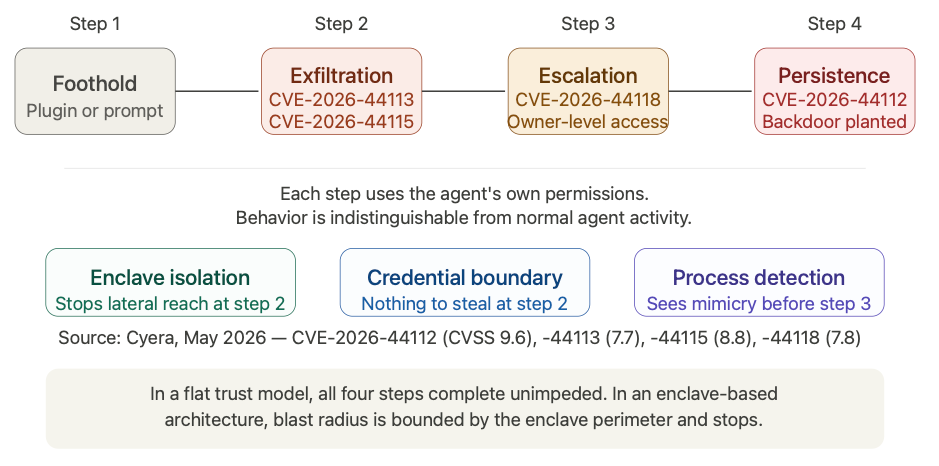
From a single foothold such as a malicious plugin or a prompt injection, an attacker could execute a four-step chain. First: gain code execution inside OpenClaw's OpenShell sandbox. Second: harvest credentials and sensitive files using TOCTOU race conditions that swap validated file paths with symbolic links outside the allowed mount root, and credential leakage through unquoted heredocs that expose environment variables including API keys and tokens. Third: escalate to owner-level control of the agent runtime by exploiting a trust flag (senderIsOwner) that OpenClaw accepted without cross-referencing the authenticated session. Fourth: deploy a persistent backdoor by redirecting write operations outside the sandbox boundary.
Cyera's researchers noted that each step mimics normal agent behavior, which is the diagnostic detail that matters most for defenders. The attacker weaponizes the agent's own privileges. The chain looks like legitimate agent activity until it does not.
The Architectural Condition That Made This Possible
OpenClaw's design assumes agents are trustworthy and should access whatever they need to perform their work. That assumption is a product decision, not a bug. Developer tools optimize for capability and convenience. The security properties of that decision become visible under adversarial conditions.
An OpenClaw agent running on a shared server instance has access to the filesystems, SaaS APIs, credentials, and execution contexts it needs to function. When that agent is compromised, those same assets become the attacker's tools. The attack surface is the agent's permissions, which in a flat trust model is nearly unlimited.
Patching the four CVEs closes the specific vectors Cyera identified. It does not change the architecture: agents and assets coexist in a space where compromise of one means exposure of the others. The next Claw Chain will use different CVEs in the same architectural condition.
Three Controls the Patch Does Not Provide
Effective AI agent containment requires controls that operate before an exploit chain completes, not after. Three specific controls address what the OpenClaw patch leaves unresolved.
Enclave-based project isolation.
Agents that work on different projects, handle different data classifications, or connect to different backend systems should operate inside separate trust boundaries where cross-project reachability is closed by architecture, not by policy. An enclave is a trust boundary that contains the agents authorized for a specific scope of work, the assets those agents are permitted to access, and the tools they need. Resources outside the enclave are not blocked by policy rules applied to a shared network; they are not network-reachable. An agent compromised inside one enclave cannot traverse to another project's assets because those assets do not exist in its network view. A Claw Chain attack that achieves code execution inside one project's enclave reaches the boundary of that enclave and stops.
Credential boundaries at the enforcement layer.
OpenClaw agents carry live API keys, database passwords, and service account credentials in memory or in environment variables, which is precisely what CVE-2026-44115 exploited. This is preventable through a credential boundary architecture where enterprise API keys and secrets terminate at the point of policy enforcement, not at the agent itself. The agent operates with substitute credentials locally; real credentials are substituted only on the outbound request at the control plane. An attacker who achieves code execution inside the agent process finds no enterprise credentials to exfiltrate. Claw Chain's credential harvesting step has nothing to harvest.
Process-level agent visibility.
Cyera's researchers noted that the Claw Chain attack mimics normal agent behavior. Network-based detection sees API calls and data flows, but it does not identify the process that generated them. A compromised OpenClaw agent making lateral file access calls looks, at the network layer, like another application communicating with local resources. Process-level detection identifies the actual process spawning the behavior, the agent runtime making the calls, and whether that agent's behavior matches its registered fingerprint and trust score. This ground-truth visibility is the detection surface for behavior that intentionally impersonates normal agent activity.
What AI Agent Isolation Actually Requires
AI agent isolation is the practice of bounding what a compromised agent can reach, not just what a healthy agent is permitted to do. The distinction matters because permissions are a pre-compromise control. Isolation is a post-compromise control. Both are necessary. Only one contains the blast radius when the other fails.
Effective AI agent isolation has three architectural requirements that apply regardless of which agent platform is in use.
Reachability, not policy, defines the boundary. A policy that says "agents on Project A cannot access Project B resources" is enforceable only as long as enforcement is functioning correctly. A network architecture in which Project B's resources are not reachable from Project A's enclave holds regardless of whether policy enforcement is functioning, compromised, or bypassed. The Claw Chain attack chain used legitimate-looking agent behavior to escalate privileges; policy-based controls that evaluate behavior are susceptible to exactly this class of attack. Reachability-based isolation is not.
Isolation must be project-aware, not just host-aware. Sandboxing an agent at the execution layer (microVMs, gVisor, hardened containers) contains what the agent can do on a single host. It does not contain what the agent can reach across the network. An agent isolated at the host layer but operating on a flat network can still traverse to databases, SaaS APIs, and credentials belonging to other projects. Enterprise AI agent isolation requires the project as a native governance boundary: the enclave perimeter maps to the project scope, not to the host boundary.
Isolation must survive agent compromise. AI agent isolation that depends on the agent behaving correctly provides no containment when the agent is compromised. The isolation boundary must be enforced by infrastructure the agent does not control: the network layer, the credential substitution layer, and the process-level detection layer. Each of these operates independently of the agent's own behavior, which is why they provide residual containment when the agent itself is the attack surface.
These requirements are not satisfied by patch management, runtime monitoring, or policy enforcement alone. They require architectural decisions about where enforcement happens, what the agent can reach, and where credentials live.
What the Patch Advisory Misses
The OpenClaw maintainers and security researchers recommend the correct immediate actions: patch, rotate secrets, identify exposed instances, audit agent access, and treat OpenClaw deployments as privileged identities subject to lifecycle controls. These are the right responses to a disclosed vulnerability in a specific tool.
They do not address the question a CISO should be asking about every AI agent deployment, patched or not: what is the blast radius if this agent is compromised?
In a flat trust model, the answer to that question is bounded only by the agent's permissions. In an enclave-based architecture, the answer is bounded by the enclave perimeter. The enclave does not depend on the agent remaining uncompromised; it contains the damage when the agent is compromised. That is the difference between a governance dashboard and architectural enforcement.
What This Means for Production AI Deployments
OpenClaw will not be the last platform with a credential exposure vulnerability or a sandbox escape chain. The category of autonomous AI agents with broad system access is growing, the attack surface is well understood by researchers, and the economics of finding and exploiting these vulnerabilities are favorable.
The controls that matter are not specific to OpenClaw. They apply to any AI agent platform deployed with access to sensitive data, credentials, or enterprise systems: enclave-based isolation that bounds the blast radius of compromise, a credential boundary that eliminates in-process secrets, and process-level visibility that provides ground truth about agent behavior rather than traffic-layer inference.
These are not new security concepts applied to a new problem. They are the extension of Zero Trust overlay architecture, proven in production enterprise environments for years, applied to AI agents operating at the access layer where the risk has now materialized.
The Claw Chain disclosure is a forcing function for that conversation. The patch closes four CVEs. The architecture question remains open.
Zentera's Ensage AI provides enclave-based AI agent isolation, credential boundary enforcement via the AI Session Controller, and process-level agent detection via zLink. For organizations evaluating AI agent security architecture, contact Zentera for a technical briefing.