
Stop IP Leaks Before They Happen.
Your critical intellectual property is digital: source code, chip designs, models, and R&D data. That makes it easy to leak. By the time DLP detects leaks, the IP is already gone. Zentera shifts the model from detection to enforcement, using Zero Trust to keep critical IP unreachable by default and accessible only through approved identities and approved methods.
Critical IP has to be accessible to create value—source code, chip designs, models, and R&D data must move between internal teams and trusted partners. That same access is what makes IP easy to leak.
Zentera shifts IP protection from “detect at the edge” to “enforce at the workload.” Virtual Chambers cloak crown‑jewel systems so they’re unreachable by default, then allow access only through approved identities and approved methods.
Legitimate work continues, but leak paths collapse.
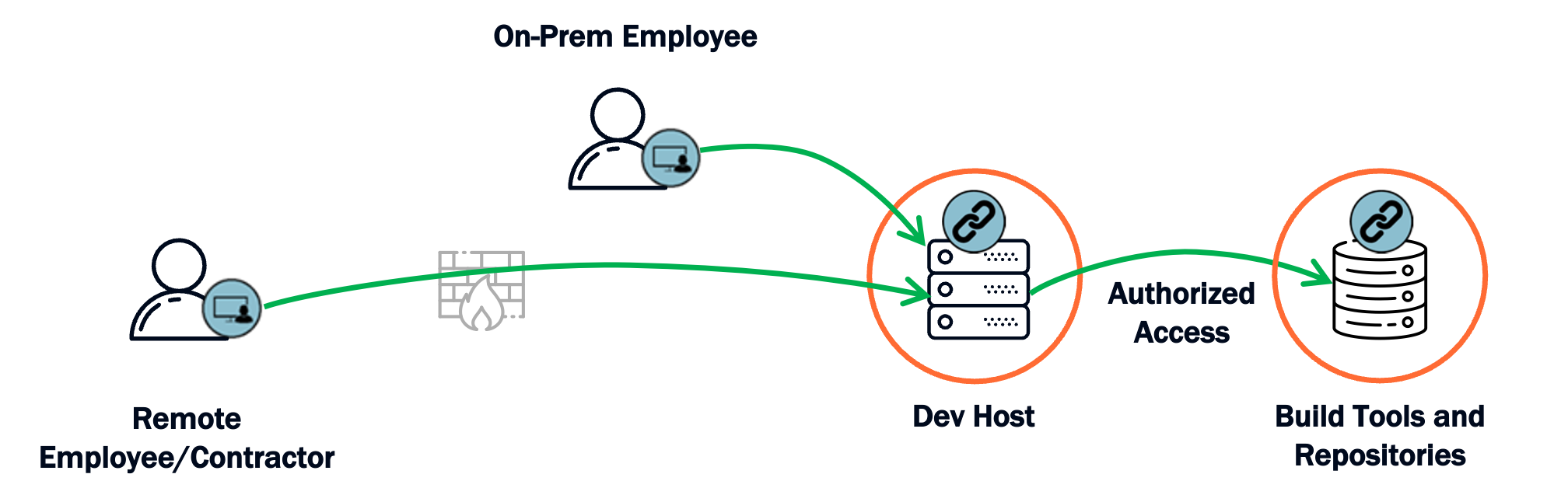
Remote contractors, vendors, and partners access development servers through ZTNA
Environment where users can interact with IP using secured and approved methods
Employees, admins, and support personnel gain access through Universal ZTNA
Internal access scoped to the user role and project
Identify the crown‑jewel IP that would materially impact competitiveness if leaked.
Map where IP is stored/processed (repos, file shares, tools and build servers, etc.) and who needs access.
Document required dependencies (IdP/AD, license servers, CI/CD, artifact repos) so protection doesn’t break workflows.
Add protection without slowing engineering. No network redesign or re‑IP required.
Deploy the Zentera control plane and connect to your IdP to leverage your existing directories/MFA.
Place enforcement where it fits: lightweight agents where supportable and inline/agentless enforcement where needed.
Turn “who should have access” into enforceable policy, down to the approved access method.
Create a Virtual Chamber around IP workloads and set deny‑by‑default rules for inbound/outbound paths.
Define least‑privilege policies for user/partner access (RDP/VNC/SSH/Web/approved clients) and enable anti‑leak controls.
Keep work moving while collapsing leak paths that turn “legitimate access” into IP loss.
Block risky behavior by default (copy/paste, file transfer, USB redirection, SSH tunneling/SCP) unless explicitly allowed.
If file movement is required, route it through an approved, logged transfer channel with optional scanning.
Prove value quickly, then expand by program, partner, or geography.
Validate workflows with R&D and Security, tune policy, and operationalize alerts for blocked/unauthorized attempts.
Scale using repeatable templates for new projects, vendors, and acquired teams—without firewall ticket churn.
Security leaders, R&D/engineering leadership, IP protection program owners, and IT/security architects
High‑tech and semiconductor, aerospace/defense, pharma/biotech, and any organization that must share sensitive IP across teams and partners
Source code, chip designs/PDKs, build pipelines, AI/ML models and training data, proprietary research datasets, sensitive documentation and design artifacts
Virtual Chambers (in‑place microsegmentation + cloaking), secure partner access without VPN sprawl, enforced access methods with anti‑leak controls, application‑aware policy enforcement
Deploy in hours/days—not months. Start with one crown‑jewel scope and expand incrementally.
Identity providers / directory services + MFA, SIEM/SOAR, optional content scanning for approved transfer channels, existing firewall/NAC programs (complementary)
Critical IP is the lifeblood of many enterprises, and because it’s digital, it’s easily copied and quietly exfiltrated. Many organizations rely on edge detection (DLP) and monitoring, but IP theft often looks like legitimate access. By the time you confirm a leak, the asset is already gone.
The real question is not “How do we keep attackers out?” It’s: can we protect crown‑jewel applications and data even when credentials, endpoints, or partner access paths are compromised? That requires enforcement: tight control over reachability and approved methods to access and move IP.
What's at stake: loss of competitive advantage and time‑to‑market, contractual and regulatory exposure, recovery cost, litigation risk, and long‑term reputational damage.
IP theft often looks like authorized access, and sensitive content can be packaged in ways that evade signatures.
You learn about the leak after the asset has already been copied out.
Network-centric isolation is slow and brittle, and exceptions accumulate as projects and dependencies change.
Teams expand trust or bypass controls to keep work moving—creating new leak paths.
VPN joins networks. It’s hard to scope access to specific assets and specific safe methods without complex infrastructure.
One compromised credential or partner device can create broad reach into sensitive environments.
Permissions control access to the file—not what happens after it’s opened (copy, sync, forward, screenshot, export).
Insider leaks and accidental exposure remain likely even with “least privilege” shares.
Response is after-the-fact. Attackers optimize for leverage before containment catches up.
Expensive incident response with irreversible IP loss.
Zentera focuses on enforcement: making critical IP workloads unreachable by default, then allowing access only through approved identities and approved methods, so theft paths disappear without disrupting legitimate work.
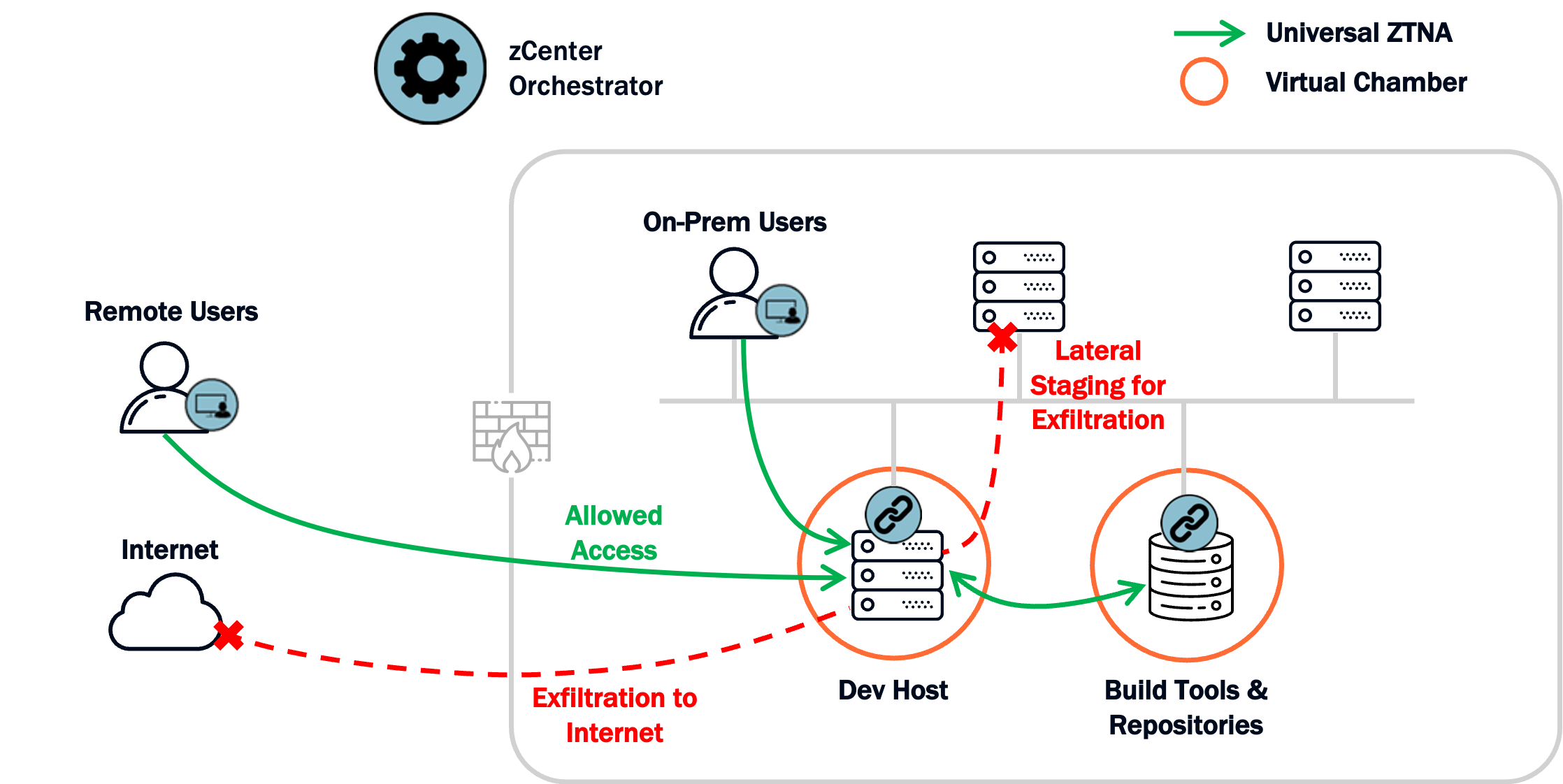
This architecture shows how Zentera overlays your existing environment to create a chambered environment to contain your IP and enforce least‑privilege access for employees, contractors, and partners. Chambers block exfiltration, while approved access methods block exfiltration through the user's machine.
Every session is authenticated via your IdP/MFA, then explicitly authorized by policy - no implicit trust based on network location.
Chambered IP workloads are unreachable by default and not easily discoverable through scanning or inherited trust paths.
Access is granted through approved methods (RDP/VNC/SSH/Web/approved clients) with anti‑leak controls that block risky transfer behavior.
Allowed access and blocked attempts are logged; approved transfer channels can be controlled and monitored for governance and compliance.
Onboard contractors and vendors in hours—not weeks—with access scoped to exactly what each project requires.
Close the gap between "authorized access" and "IP walks out the door" by blocking the leak paths that policies alone can't stop.
Go live in days and show auditors exactly who accessed what, how, and what was blocked—without months of implementation.
Instantly microsegment and cloak IP workloads in place so they’re unreachable by default. No network redesign required.
Constrain high‑risk behaviors (tunneling, SCP, USB redirection, copy/paste) and route approved transfers through logged, scannable channels.
Tie policy to identity, device, and application/process context to restrict unauthorized tools and limit the value of stolen credentials.
Agility you just don't have in a traditional infrastructure
With the CoIP Platform, we are able to protect our IP and segment our resources across worldwide infrastructures almost instantly.
Talk to our architects about your specific security challenges.
Get expert guidance on your OT security strategy
Schedule a Call 30-minute consultation© 2026 Zentera Systems, Inc. Terms of Service Privacy Policy Open Source