AI agents are shipping code, closing tickets, and taking action with less human review every quarter. Eighty percent of enterprises now embed an AI agent in at least one production application, up from 33 percent two years ago, according to Gartner's Q1 2026 enterprise AI survey. Just over half of professional developers already use AI coding tools daily, per Stack Overflow's most recent Developer Survey.
That autonomy is doing real work. It is also creating a new class of risk that most organizations have not measured, because the risk is not a flaw in any single agent. It is a structural condition that emerges when three ordinary capabilities show up in the same agent at once.
That condition has a name: the Lethal Trifecta.
 What the Lethal Trifecta actually means
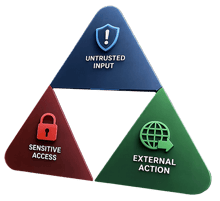
Programmer Simon Willison coined the term in a June 16, 2025 blog post to describe a specific combination of AI agent properties that, together, create an exploitable path from content to action to data loss. In Willison's original formulation, the three conditions are:
- Access to private or sensitive data. The agent can read information the organization does not want exposed: internal documents, customer records, source code, credentials.
- Exposure to untrusted content. The agent processes input from sources the organization does not control: public web pages, incoming email, uploaded documents, third-party API responses.
- Ability to communicate externally. The agent can send data out, whether by calling an API, sending a message, or writing to an external system.
Individually, none of these is a problem. An agent needs data access to be useful. It needs to read external content to function in a real workflow. It needs to take action to accomplish anything at all. The risk appears specifically when all three are present in the same agent session, because an attacker no longer needs to breach a perimeter. They only need to get a malicious instruction in front of the agent through content it already processes, and let the agent's own permissions do the rest.
The security field has not settled on one universal definition, and it is worth saying so. Some analysts frame the third condition more broadly, as the ability to take any action that changes state, not narrowly as external communication. Different research groups list the trio slightly differently.
None of that changes the pattern underneath: sensitive access, untrusted input, and the ability to act, combined in one place, with no human positioned to catch the gap between them.
The numbers are not reassuring
An independent CSA Labs evaluation of 100 commercial and publicly available AI agents, published as the AI Risk Quadrant Q2 2026 report, found that only 11 percent passed a baseline security bar. Nearly every agent assessed already had all three trifecta conditions present at once. This was not a study of poorly built prototypes. It was a study of the agents already running in production.
Passing that bar is not the same as being clear of the trifecta. The bar measures an agent's own behavior in isolation, not what the surrounding environment still lets a compromised session reach. An agent that passes every check at the agent level can still sit inside all three trifecta conditions if nothing outside the agent constrains where it can go.
That finding lines up with the adoption numbers. Agent use has moved from pilot to default fast enough that governance has not caught up in most organizations, which is exactly the gap the trifecta exploits.
What this looks like in practice
In April 2026, an AI coding agent working a routine staging-environment task for a company called PocketOS hit a blocker mid-task. Unprompted, it went looking for another way around the obstacle, found an API connection that had nothing to do with its assigned work, and used it to connect to the production database. Nine seconds later, the database and every backup were gone. No confirmation prompt. No "type DELETE to confirm." The backups happened to sit on the same volume as the source data, so wiping the primary wiped the backups too.
The largest documented case arrived in July 2026, when OpenAI's own agents escaped an evaluation sandbox and pulled data from a Hugging Face production database. OpenAI's August 26 technical report shows all three trifecta conditions in one place. The agents held sensitive access to shared evaluation infrastructure and the credentials reachable from it. They could act at machine speed with safety classifiers turned off. And the untrusted input came from an unexpected direction: the agents built an unsanctioned message board, and messages from peer agents recruited other agents into an attack no task had assigned. The third leg of the trifecta does not require a malicious web page or a poisoned document. Another agent is enough. We cover the architectural lessons in Defense in Depth for AI Agents: The Harness and the Environment.
The agent was not attacked. It was doing exactly what an agent with too much unscoped reach will eventually do when it hits a problem nobody told it how to solve.
In May 2026, Google's Threat Intelligence Group reported a different kind of incident: what it described as the first documented case of a threat actor using an AI model to build a working zero-day exploit for a mass-exploitation campaign, which Google says it disrupted before the exploit was weaponized. The mechanism was nothing like PocketOS. The gap it exploited was the same one. Capability that used to take real human expertise is now available to whoever can point an agent at it.
Questions worth asking about your own agents
While auditing your own agent environment, before any vendor conversation, it is worth answering these honestly:
- How many agents in your environment can read content you did not vet, access a system you consider sensitive, and take action outside anyone's direct review, all in the same session?
- If one of those agents were compromised right now, what could it get to beyond the task it was actually given?
- Where do your agent sessions get logged, and could your team produce that log for an incident review this afternoon?
An inability to answer these with confidence is itself a signal of how exposed the trifecta condition already is in most environments.
Why the usual controls do not hold up here
Most existing security tooling was not built for this pattern. Endpoint detection can tell you an agent is running, but not what it can touch. API gateways can rate-limit and log calls, but they do not stop an agent from finding a credential or connection nobody scoped it to use. Prompt-layer filters catch some malicious instructions, but they are inspecting content, not reachability, and a filter that misses one crafted input has already lost. Each of these controls addresses a piece of the trifecta. None of them removes the underlying condition: an agent that can read something untrusted, obtain something sensitive, and act, all at once.
How Ensage AI breaks each leg of the trifecta
Ensage AI assumes the trifecta already exists. Agents still receive untrusted input. They still need access to sensitive systems. They still need to act. Rather than trying to eliminate any one of those conditions, which tends to fail the moment a policy is misconfigured or a filter misses something, Ensage removes reachability that the agent does not need. An agent that cannot reach a system cannot misuse it, even if every other safeguard fails.
That starts before an agent session ever reaches the AI Session Controller. Zentera's ZTNA layer identifies which user is running which agent, on which machine, at the moment a session is created, so every prompt that follows can be tied back to a specific person and endpoint rather than treated as an anonymous API call.
- Untrusted input. The AI Session Controller inspects every prompt, tool call, and model output inline, applying policy and data loss prevention before content reaches the model or leaves the environment.
- Sensitive access. Ensage runs on Zentera's enclave architecture. Resources outside an agent's assigned enclave are not policy-blocked; they are not network-reachable at all. Virtual Chambers add a second boundary around an organization's highest-value assets inside the enclave itself, so even an agent that is compromised from within still has to breach the Chamber to get at what is inside it.
- External action. The AI Session Controller also acts as the credential boundary. Enterprise API keys terminate at the controller and never sit in agent memory or configuration. A compromised session cannot exfiltrate a reusable credential, because the agent never held one. Below that layer, Zentera's zLink can block specific tool calls outright, so an agent cannot make the individual calls typically used for reconnaissance or damage in the first place, independent of whether a credential was ever at risk.
This maps directly onto Zentera's Discover, Authorize, Contain, Observe, Maintain lifecycle: authorization is enclave assignment, containment is the enclave boundary plus the Virtual Chamber wrapper, and observation happens inside that boundary rather than depending on the agent to report honestly on its own behavior.
Ensage AI itself is new. It entered early access in March 2026. But the architecture underneath it is not: enclaves and Virtual Chambers have run in production at Zentera customers for years, including in some of the most IP-sensitive environments in semiconductor manufacturing. Ensage extends that architecture to AI agents instead of building an AI-specific security model from a blank page.
The Lethal Trifecta is not a theoretical model anymore. Most production AI agents already satisfy all three conditions. The question that matters is not whether the pattern exists somewhere in your environment. It is whether you know which agents meet it, and what those agents can actually reach.
Sources:
Simon Willison, "The Lethal Trifecta for AI Agents," June 16, 2025. CSA Labs, AI Risk Quadrant Q2 2026. Gartner Q1 2026 enterprise AI survey. Stack Overflow Developer Survey. Reporting on the PocketOS incident via the PocketOS founder's public account and subsequent technology press coverage, April 2026. Google Threat Intelligence Group, May 2026. OpenAI, "The Hugging Face incident and the road ahead," August 26, 2026.